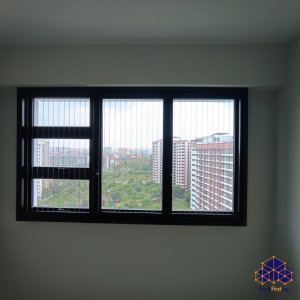
The invisible grille BTO installation has become a standard consideration for new flat owners moving into their Build-To-Order units. These high-tensile stainless steel wire systems offer safety without the visual bulk of traditional grilles, preserving the clean lines and open feel that modern BTO interiors demand. For families with young children or pets, the invisible grille BTO solution provides essential fall protection while maintaining the unobstructed views that make high-rise living enjoyable.
However, BTO flats come with specific considerations that differ from resale HDB units. The rules governing invisible grille BTO installations reflect the fact that these are new builds with established facade designs and colour schemes. Understanding these regulations before engaging any contractor saves time, money, and the frustration of forced removals.

Where Invisible Grille BTO Installation Proceeds Without Approval
For most areas of a BTO flat, invisible grille BTO installation does not require prior HDB approval. Living room windows, bedroom windows, and kitchen windows fall into this category. Homeowners may proceed with invisible grille BTO installations in these locations without submitting formal applications, provided the grilles remain fixed internally and do not protrude from the building’s main facade.
This internal installation requirement means the invisible grille BTO system sits behind the window itself, preserving the external appearance of the BTO block. The grilles must not obstruct window openings or protrude more than 50mm from the external wall. These conditions ensure that invisible grille BTO installations do not alter the uniform facade that characterises HDB estates.
The straightforward approval process for internal windows makes invisible grille BTO an attractive option for new flat owners. Many homeowners appreciate the ability to enhance safety without navigating complex paperwork.
Service Yard and Balcony: Where Invisible Grille BTO Requires Approval
The situation changes significantly for service yards and balcony parapets. Invisible grille BTO installation at these locations requires HDB approval, and the grilles must comply with approved designs specified in the relevant HDB factsheet. Homeowners can review approved grille designs through My HDBPage before making any decisions.
Service yards in BTO flats present a particular consideration. HDB does not typically provide windows at the service yard, and a permit becomes necessary to install windows in this area. The invisible grille BTO installation for service yards must follow approved designs, and the grilles installed must comply with HDB guidelines in terms of design and colour.
For balcony areas, installation of windows or full-height glass panels is prohibited because the space must remain naturally ventilated at all times. Homeowners may consider invisible grilles or approved balcony grille designs indicated in the Residents’ Handbook. The height of invisible grille BTO installations must not exceed the height of the unit.
The Contractor Requirement for Invisible Grille BTO
HDB regulations mandate that only BCA-approved window contractors listed with HDB may carry out any window works. This applies to both new installations and replacements of invisible grille BTO systems. Engaging an unlicensed contractor violates regulations and puts safety at risk.
For the replacement or reinstatement of safety barriers integrated with windows, the law requires that the work be carried out or supervised by a trained window installer who has completed BCA’s specific module on safety barriers. This requirement exists because improper installation compromises the very safety that invisible grille BTO systems are meant to provide.
Homeowners can verify a contractor’s registration through the HDB InfoWEB or by calling the HDB Service Line at 1800-2255432. The consequences of non-compliance are significant. Under the Housing & Development (Renovation Control) Rules, it is an offence to fail to engage a registered contractor. On conviction, homeowners face court fines of up to SGD 5,000. In addition to the fine, all unauthorised works must be removed and reinstated to original condition.
A competent invisible grille BTO contractor demonstrates clear understanding of these regulations. They explain the distinction between internal windows that do not require approval and service yards and balconies that do. They advise on the correct mounting method whether frame mounting or wall mounting suits the specific window frames in the BTO unit. They specify the grade of stainless steel used and explain the tensioning system that prevents wires from bowing over time.
Material and Design Requirements for Invisible Grille BTO
Material choice directly affects the durability and compliance of any invisible grille BTO installation. HDB approves aluminium, stainless steel, and wrought iron for window grilles. Stainless steel, particularly marine-grade 316, provides excellent corrosion resistance and durability in Singapore’s tropical climate. High-quality invisible grille BTO systems use high-tensile stainless steel wires with secure anchoring systems and corrosion-resistant coatings.
The colour of invisible grille BTO installations must align with HDB’s original specifications. Window frame and grill colours should match those provided by HDB to maintain a consistent facade for the block. Changing window types—for example, switching from casement to sliding panels—is not permitted.
Safety Spacing for Invisible Grille BTO
Safety spacing represents one of the most critical considerations for invisible grille BTO installations. HDB standards specify that gaps in safety barriers must not exceed 100mm. For invisible grilles, common spacing options include 2 inches for homes with toddlers and cats, 3 inches for most families, and 4 inches for homes without small children. Professional installers customise spacing based on household needs while remaining HDB-compliant.
The spacing directly affects both safety and cost. Tighter spacing requires more material and labour, increasing the invisible grille BTO installation cost. However, the investment in proper spacing provides essential protection for young children and pets.
Cost Considerations for Invisible Grille BTO
The invisible grille BTO installation cost varies based on several factors. Pricing typically follows a per-square-foot model, with rates ranging from SGD 8 to SGD 10 per square foot for standard installations. Individual windows generally cost from approximately SGD 120 per location.
Several factors influence the final invisible grille BTO cost. Wire spacing affects both safety and price (e.g. tighter spacing of 2 inches costs more than standard 3 to 4 inch spacing). The installation area matters, as well. Windows present simpler installations with lower costs, while balconies demand stronger tension systems and more complex layouts. Material quality also plays a role, with marine-grade stainless steel 316 commanding a higher price than coated alternatives.
Conclusion
The invisible grille BTO installation offers new flat owners a practical balance of safety, aesthetics, and compliance. Understanding the distinction between internal windows that do not require approval and service yards and balconies that do forms the foundation of a successful project. Engaging a BCA-approved contractor who understands HDB regulations and material specifications ensures the installation remains legal and safe. Proper safety spacing and quality materials provide lasting protection without compromising the clean, open feel that makes BTO living enjoyable.
FixFirst provides transparent invisible grille BTO consultations with full HDB compliance assurance and professional installation by BCA-approved contractors. Contact FixFirst today for a site assessment and receive an accurate quote tailored to your BTO flat.